Where to Buy in Antigua:
Six Areas Compared
Where to Buy in Antigua: Six Areas Compared
Antigua, part of Antigua and Barbuda, an independent nation, has no single best area to buy: Jolly Harbour is the largest masterplanned community, English Harbour and Falmouth Harbour short-term rentals commonly earn $180 to $300 a night in peak season, and Jumby Bay properties have averaged around $5 million. Non-citizens pay a 7% Non-Citizen Land Holding Licence wherever they buy, as at September 2026.
Key takeaways
Property tax: Annual property tax in Antigua is estimated at 0.1-0.5% of assessed value.
Rental occupancy: Short-term rentals in Dickenson Bay are estimated at about 65% occupancy.
Nightly rates: English Harbour short-term rentals are estimated at $180-300/night.
Rental income: Well-managed properties are estimated to earn $2,500-6,000/month in gross revenue.
Antigua and Barbuda is an independent nation and sets its own property, tax and immigration law.
Ask five different agents where to buy in Antigua and you will likely get five different answers, mostly because the island does not have one obvious best area. It has half a dozen distinct ones, each suited to a different kind of buyer.
Key facts
Legal framework: Antigua and Barbuda is an independent nation and sets its own property, tax and immigration law. (Verified)
Neighbourhood characteristics and relative positioning (Jolly Harbour, English/Falmouth Harbour, Nonsuch Bay, Jumby Bay, Mill Reef, Dickenson Bay) (Corroborated)
Short-term rental performance figures (Dickenson Bay ~65% occupancy, English Harbour $180-300/night, $2,500-6,000/month gross revenue for well-managed properties) (Estimate)
Annual property tax 0.1-0.5% of assessed value (Estimate)
Jolly Harbour
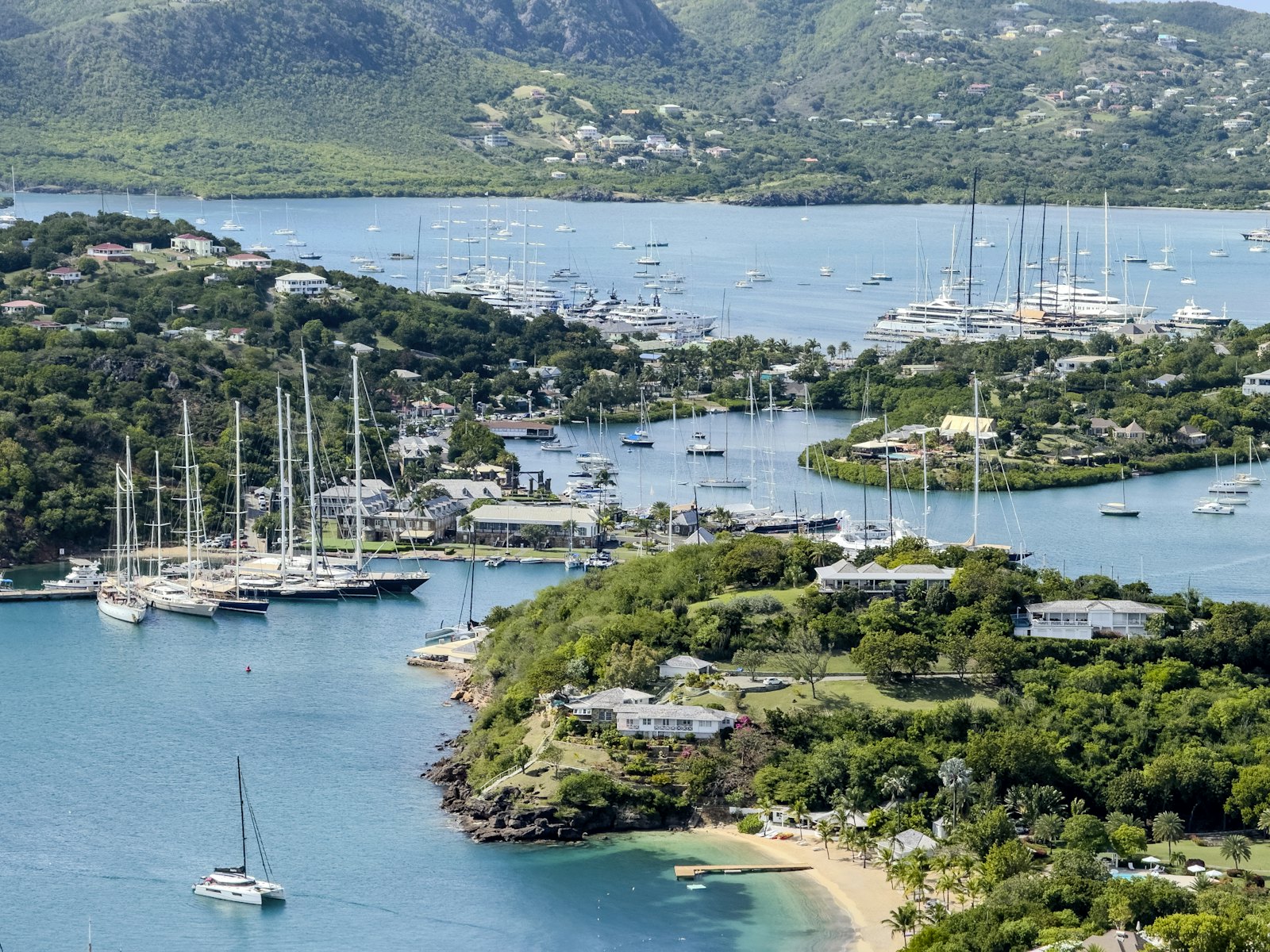
Jolly Harbour, on the west coast, is Antigua's largest masterplanned community: a marina, a golf course, restaurants and several residential enclaves built around it. It draws a broad mix of buyers, from retirees to families, and the sheer volume of similar apartments on the market means well-priced, well-presented units sell faster than generic ones sitting on price alone. It suits a buyer who wants amenities on the doorstep and does not need seclusion.
English Harbour and Falmouth Harbour
English Harbour, home to the historic Nelson's Dockyard, and neighbouring Falmouth Harbour carry a different character: yachting culture, a lively social scene during the winter season, and genuine historic charm alongside modern conveniences. Short-term rental rates here run higher than most of the island, commonly $180 to $300 a night in peak season, reflecting demand from the sailing crowd rather than resort tourism. Buyers drawn to a working harbour atmosphere over a beach-resort one tend to end up here.
Nonsuch Bay
On the less-developed, breezier east coast, Nonsuch Bay Resort has built a reputation around sailing, with warehousing for yacht captains and a dedicated Port of Entry among its plans. It positions itself at the premium end, attracting buyers willing to pay for exclusivity and a quieter coastline than the west side offers.
Jumby Bay and Mill Reef
At the very top of the market sit Jumby Bay, a private island off the north coast where properties have averaged around $5 million, and Mill Reef Club near Fitches Creek. Both are ultra-scarce, low-turnover enclaves that have appreciated more than almost anywhere else on the island over the past five to ten years, largely because so little comes to market. These are not areas for a first-time Caribbean buyer testing the water; they suit established owners who already know Antigua well.
Dickenson Bay
Dickenson Bay, on the north-west coast, is one of the island's more reliable short-term rental performers, with strong Airbnb occupancy reported around 65% and consistent family demand. It sits closer to St John's amenities than the harbour areas, which appeals to buyers who want rental income without sacrificing convenience.
What buying here actually costs, wherever you choose
Wherever the location, the purchase mechanics stay the same: non-citizens need a Non-Citizen Land Holding Licence, currently 7% of the purchase price following the 2020 amendment, and financing options for foreign buyers remain limited, with the market leaning heavily towards cash purchases regardless of area. Annual property tax is generally light by international standards, though the exact rate depends on the assessed value and should be confirmed with a local attorney rather than assumed from a general guide.
Getting the area right before the property
The honest advice from agents working across all six areas is the same: visit in both high and low season if possible, since Jolly Harbour and Dickenson Bay feel very different in August than in February. Renting for a month in the target area before committing to a purchase remains one of the more underused pieces of due diligence available to overseas buyers, and it costs far less than discovering after completion that the neighbourhood was the wrong fit.
Questions and answers
What is the best area to buy property in Antigua?
Antigua does not have one obvious best area; it has half a dozen distinct ones, each suited to a different kind of buyer. Jolly Harbour suits buyers who want amenities on the doorstep, English Harbour and Falmouth Harbour suit those drawn to a working harbour atmosphere, and Jumby Bay and Mill Reef sit at the very top of the market.
How much do short-term rentals earn in English Harbour, Antigua?
Short-term rental rates in English Harbour and Falmouth Harbour commonly run $180 to $300 a night in peak season, higher than most of the island.
How much does property cost on Jumby Bay in Antigua?
Properties on Jumby Bay, a private island off the north coast, have averaged around $5 million. Jumby Bay and Mill Reef Club are ultra-scarce, low-turnover enclaves.
What rental occupancy does Dickenson Bay in Antigua achieve?
Dickenson Bay reports strong Airbnb occupancy of around 65% and consistent family demand.
What licence do foreigners need to buy property in Antigua?
Non-citizens need a Non-Citizen Land Holding Licence, currently 7% of the purchase price following the 2020 amendment, wherever they buy. Financing options for foreign buyers remain limited, and the market leans heavily towards cash purchases.
Related guides
More on Antigua and Barbuda
Antigua's Property Market in 2026: What Agents Report and What Is Missing
Beyond the Beaches: Nelson's Dockyard, Devil's Bridge and Barbuda's Communal Land
Similar guides for other islands
Best Areas to Buy in St Kitts and Nevis: Frigate Bay to Nevis Peak
Best Areas to Buy in Guadeloupe: Saint-François, Le Gosier, Deshaies and the Outer Islands
Best Areas to Buy in Martinique: Les Trois-Îlets, Sainte-Anne, Le Diamant and the Atlantic Coast
About the data
Figures are the latest available as of September 2026. Next review due March 2027.
This guide draws on 4 sources: 4 agency, adviser or other published source.
2 figure(s) are marked Estimate.
Fact statuses: Verified means stated by a primary or official source (Verified (see note) adds a caveat). Corroborated means several independent sources agree, but no primary source was found. Estimate means a single source, an agency figure or an asking price. Disputed means sources conflict. Calculated by Pan Caribbean means our own arithmetic from the figures shown.
Sources and checks
Researched September 2026. Next review due March 2027.
7th Heaven Properties: Antigua and Barbuda real estate listings (agency, adviser or other published source)
The Latin Investor: which area of Antigua to buy in (agency, adviser or other published source)
Country Life: dream houses on Antigua (agency, adviser or other published source)
RE/MAX 365 Antigua: property listings (agency, adviser or other published source)
About Pan Caribbean
Pan Caribbean is a property listing portal and market data platform covering 23 markets across the Caribbean. Buyers, investors, agents and developers can search, compare and research property throughout the region, all in one place.
This guide gives general information, not legal, tax or financial advice. Pan Caribbean is not an estate agent or broker and does not act in any sale or purchase. Confirm the details with a licensed local adviser before acting.
Explore related blogs
View All
Best Areas to Buy in Dominica: Roseau, Portsmouth, the South, the West Coast and the North
Where to Buy: Area Guides
Best Areas to Buy in Martinique: Les Trois-Îlets, Sainte-Anne, Le Diamant and the Atlantic Coast
Where to Buy: Area Guides
Best Areas to Buy in Guadeloupe: Saint-François, Le Gosier, Deshaies and the Outer Islands
Where to Buy: Area Guides
Best Areas to Buy in St Vincent and the Grenadines: Villa, Bequia, Union Island and Beyond
Where to Buy: Area Guides
Looking for Properties?
Browse homes that match your needs and budget with expert support and personalized advice to help you find your perfect Caribbean property. Get started within 5 days for quality advice to begin searching.